



TO FAIL IS TO BE HUMAN. TO BE HUMAN IS TO CREATE.
Transcript of TED Talk-style presentation about human creativity and failure originally written for the “Looking Up While It All Falls Down” panel program at MNCBA FallCon 2026. Scroll to end for audio/video presentations.
PART ONE: ACCEPTING FAILURE
My name is Jen Bateman. I am an artist, illustrator, photographer, writer, and speaker. I am President and Creative Director of the Minnesota Comic Book Association. I am a partner, a friend, a coworker, a volunteer — and occasionally — a real pain in the ass.
I am also a failure.
I have failed in so many ways, let me tell you…
As a child growing up, I was the weird one. I know, right? Can you believe that?! It’s true. I failed at making and keeping more than one or two friends at a time. I failed at being cool. I failed at being popular. Sometimes it felt like I failed at everything that mattered.
I failed in high school when the classes suddenly got really boring and I couldn’t focus and — oh, by the way — I had unmedicated ADHD and I needed glasses. I failed to meet my parents’ high expectations by getting a few Cs and Ds instead of straight As.
I dropped out of the local community college after six weeks and never went back.
I left Texas and moved to Minnesota for the first time in 2000, and then to Buffalo, NY, to pursue a romantic relationship. Ah, to be young and stupid, right? After barely a year of failing to survive on my own in two different states, I moved back into my parents’ house with nothing more than my desktop computer, a few trinkets, and some clothing to my name.
My early 20s were preoccupied with a succession of failed relationships as I desperately sought the love and approval from others that I could not give to myself.
By 2005, I had become successful as an independent creator and then imploded. I buckled and collapsed under the psychological pressures of my own success until I was nearly suicidal. Failure was so comfortable and familiar that I unwittingly self-sabotaged.
In my own apartment in Texas, I failed to survive on my own for a second time, living off credit cards while severely depressed and sick. I ultimately had to file for bankruptcy.
A few years later, I was my mother’s daytime caregiver for several months until she passed away from metastatic breast cancer. While planning her funeral, my father confessed to me that all of his children — of which I am the oldest — were disappointments. I had failed to become a doctor or lawyer, which was what he had wanted of me. Of course.
I dated and then married the wrong person because I failed to know and understand myself well enough to create a healthy relationship. I failed to recognize my broken attachment patterns and trauma. I failed to communicate, to be emotionally available, to get therapy, and to ask those things of my spouse. We divorced in 2015 after I had an early mid-life crisis.
I loaded all of my belongings that would fit in a small U-Haul trailer, hitched it to my pickup truck — yes, really — and returned to Minnesota to start over again, again, again…
By 2019, I had become successful as an independent creator again and then imploded again. I had taken up the mantle of my past persona and pen name while failing to realize that I hated doing that and being that, actually. I was blindly trying to “do over” the past, as if I could somehow “undo” the litany of my previous failures by getting it right — this time!
I launched a new webcomic which sputtered out and died after only a few updates because the version of me that created it had ceased to exist. The remains of that failure were given new life in my current autobiographical webcomic, Behind the 8-Ball.
In 2025, Behind the 8-Ball was nominated for a Silver Reuben award by the National Cartoonists Society and — I’m sure you can see this one coming — I lost.
Behind the 8-Ball has many themes, but one of the most important is failure.
The story of my life is the story of how other people have failed me, how I have failed other people, and crucially, how I have failed myself. That is the story of all of our lives. We fail at the little things, and we fail at the big things. I am sharing my failures with you because it is easy for us to forget that for every visible success, there are innumerable hidden failures.
Like death, there is no timeline in which any of us escape the experience of failure.
Your agency lies in what you choose to do with it.
PART TWO: PROCESSING FAILURE
The message that I want you to take away is this:
To fail is to be human. To be human is to create.
It is my personal belief that toxic shame, often a byproduct of failure, is one of the most destructive forces in our society today. Take, for example, a man who cannot find fulfilling work to support his family. He may view his own feelings of failure with compassion, and as a result, channel his energy into other actions that could improve his long-term circumstances.
Or he may internalize his feelings of failure as toxic shame, and turn his self-loathing outward, projecting it as hate for people who look or live differently from him. He may abuse or bully those less powerful than him. He may eventually end his own life.
According to the FBI, the reported rate of hate crimes doubled between the years 2015 and 2024 following a period of general decline. Abuse and bullying have become more common and more severe in tandem with the ubiquitousness of social media. We are all constantly being made to feel like failures for not measuring up to arbitrary standards we never agreed to.
Am I attractive enough? Thin enough? Successful enough? Popular enough?
According to CDC data, the suicide rate increased by 32% between the years 2000 and 2024. Suicide is the tenth leading cause of death in the United States. Suicide is the second leading cause of death among youth and young adults between the ages of 15 and 34.
In my opinion, it’s not a coincidence that these alarming trends are occurring at the same time as increasing economic and political instability around the world.
The inability to process feelings of failure in a healthy way is literally killing us.
My father told me, when I was thirty years old, that I was a disappointment for not growing up to be a doctor or lawyer. My father, a blue-collar worker who did not go to college or University, had carried deep feelings of personal failure for as long as I knew him. He was the one disappointed that he had not become a doctor or lawyer. That was his failure, not mine.
My father never learned to separate failure from his value as a human being.
My father never sought or accepted help. He committed suicide in 2016.
Because I am able to give myself grace; because I know that my failures do not define me; and because I am aware of my own inherent worth — I am here speaking to you today. Like my father, I am a blue-collar worker who did not go to college or University. But unlike him, I have channeled a lifetime of failures into doing what I can to make the world a better place.
Instead of allowing failure to destroy me, I repurposed it into a creative force.
After all, if you fail — it means you had the courage to try.
Sometimes failure is about doing the best we can with the life experience and tools we have at the time. Sometimes failure is about external circumstances almost, or completely, out of our control. Sometimes failure sneaks up on us and catches us by surprise. Sometimes we see failure coming but have no ability to stop it — we can only brace ourselves for impact.
Failure is not a judgement, nor does it have to be a life sentence. Failure is not inherently good or bad — but merely information. If we learn how to tolerate the uncomfortable feeling of failure and listen to what it is trying to tell us, it becomes an opportunity to learn and grow.
It’s okay to be angry, disappointed, frustrated, and sad. But don’t dwell there.
Through failure we figure out who we are, what we want, what we don’t want, the things that are most important to us, and the kind of lives we want to lead. Overcoming failure builds up our resilience and fosters a sense of purpose. For me, that became an effort to prevent others from needlessly suffering by empowering them to learn from my mistakes.
Now — maybe you’re finding yourself thinking — Okay, Jen. You create comics. You lead a comic book convention. And you’re standing here talking about failure. What’s the unifying thread? How does this all come together in a way that is going to help me?
I hear you. I see you. Let’s get to the good stuff…
PART THREE: GROWING FROM FAILURE
Multiple empirical research studies, including those by J.M. Adler published in the Journal of Personality and Social Psychology, Qualitative Psychology, and the Personality and Social Psychology Review, point to the power of story with regard to our identity development and well-being. The narratives we tell ourselves can become self-fulfilling prophecies.
When you pick up a pen and become the scribe of your own life, you are no longer a victim of circumstances or a performer contorting yourself to meet external expectations. Failure becomes a temporary setback; a bump in the road on this beautiful, terrifying, joyous, painful, over-arching journey that is a human lifetime. You fall down. You get up. You keep going.
Do you remember when I said at the beginning of this talk that I can occasionally be a real pain in the ass? Every one of us has days when we are not at our best — even me.
All right — as much as I try — especially me. I am unapologetically alive.
But here’s the thing: I can forgive myself for my shortcomings because I know, in my heart, I am doing my best. If something in my life has failed or is not going the way I planned, I allow myself appropriate time to grieve, lick my wounds, and then I examine it.
I ask myself questions like: What went wrong here? What went right? What could be better? How could I approach a similar situation differently in the future? Was this even what I truly wanted? If not, what is it that I do want? How does this experience fit into the story of my life? What does it say about me as a person? How do I feel about it? Why?
…Why?
The exploration prompted by these questions eventually becomes the blog posts, essays, poems, artwork, videos, private journal entries, and yes — comic strips — that I create to share my experiences with the world. I have failed in so many ways that it is not possible to recall or name them all. And if I had the choice, I would do it all again, because every single one of those failures formed me into the person I am today. I would not be here otherwise.
Behind the 8-Ball would not exist otherwise. And so on…
I may be a little biased, but it is my belief that comics are a uniquely well-suited medium to help us develop empathy and understanding for both ourselves and others. The versatility of comics enables us to portray humanity in nuanced, thoughtful, and richly layered ways.
The weight of a line, the style of a letter… comics are profoundly emotive.
Who are you? What is your purpose? What is the story you’re telling yourself?
The good news is that you do not have to give up your day job and go to art school to reap the benefits of this process. All you need is a pencil, a few sheets of paper, and your growth mindset. Use stick figures if you cannot draw. This is about embracing your imperfect, human creativity to take control of your story and become your authentic self. Do it for you.
I use my journal to practice mindfulness every single day. No exceptions.
It helps me to make sense of the people and situations going on around me. It holds me accountable to myself for my own progress — or lack thereof. It enables me to reflect upon whether the choices I make every day are in alignment with my long-term goals.
Am I happy? Frustrated? Content? Overwhelmed? Lonely?
Great! Let’s create something with it!
We are living through difficult, uncertain, and often frightening times, and it is easy to feel like we have failed collectively as a society and succumb to despair. It is not my goal to invalidate the all-too-real challenges and struggles threatening our present and future.
However, from my own perspective, when you do the hard thing and consistently make the effort to put your own house in order — and by that I mean the things going on inside of your heart and your mind — it makes all those external circumstances feel more manageable. The act of overcoming personal failures builds the strength to weather external obstacles.
It also helps keep the hope alive that life can get better.
We all fail and stumble from time to time — every single one of us. You are not alone. Failure, pain, and hardship are all part of the experience of being human. Failure can often be a catalyst for creativity and a gateway to bigger and better things if you allow it to be.
I hope I have inspired you to start creating today. Thank you.
AUDIO/VIDEO PRESENTATIONS
Audio recording with images/photo slides from the artist’s life.
Click here to watch it on YouTube!
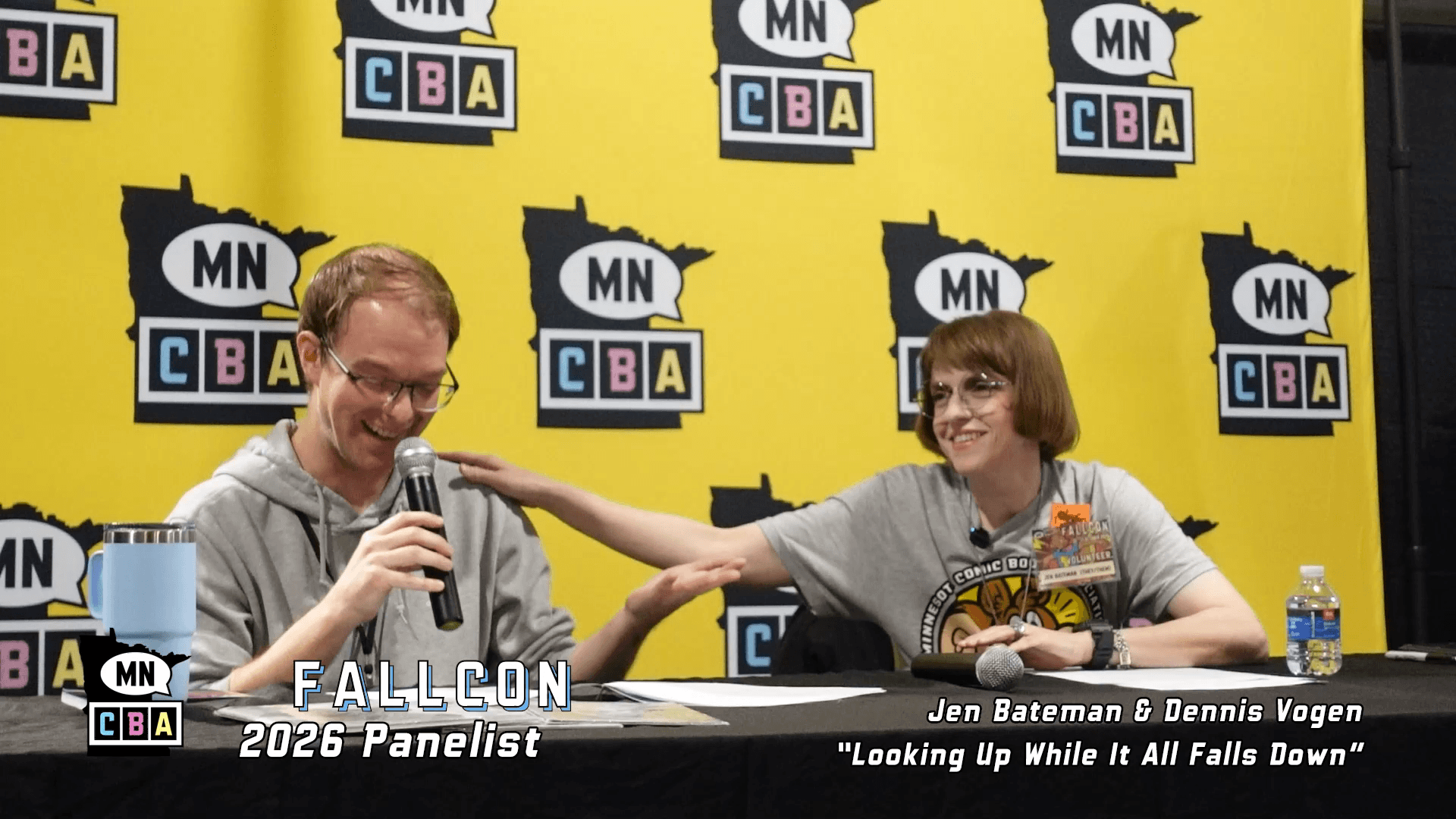
MNCBA FallCon 2026 Panel “Looking Up While It All Falls Down” with Jen Bateman and Dennis Vogen
Saturday, 10 Oct 2026 at 3:00PM
MNCBA President Jen Bateman and celebrated, multi-disciplinary creator Dennis Vogen share their personal experiences of cultivating creativity and mindfulness to survive — and even thrive — in turbulent times. (Content Warning: Discusses suicide and other sensitive topics.)
Panel Moderator: Eric Childs
Videography: Rusty Detty
Click here to watch it on YouTube!